Bing Webmaster Tools: the AI visibility lever nobody switches on
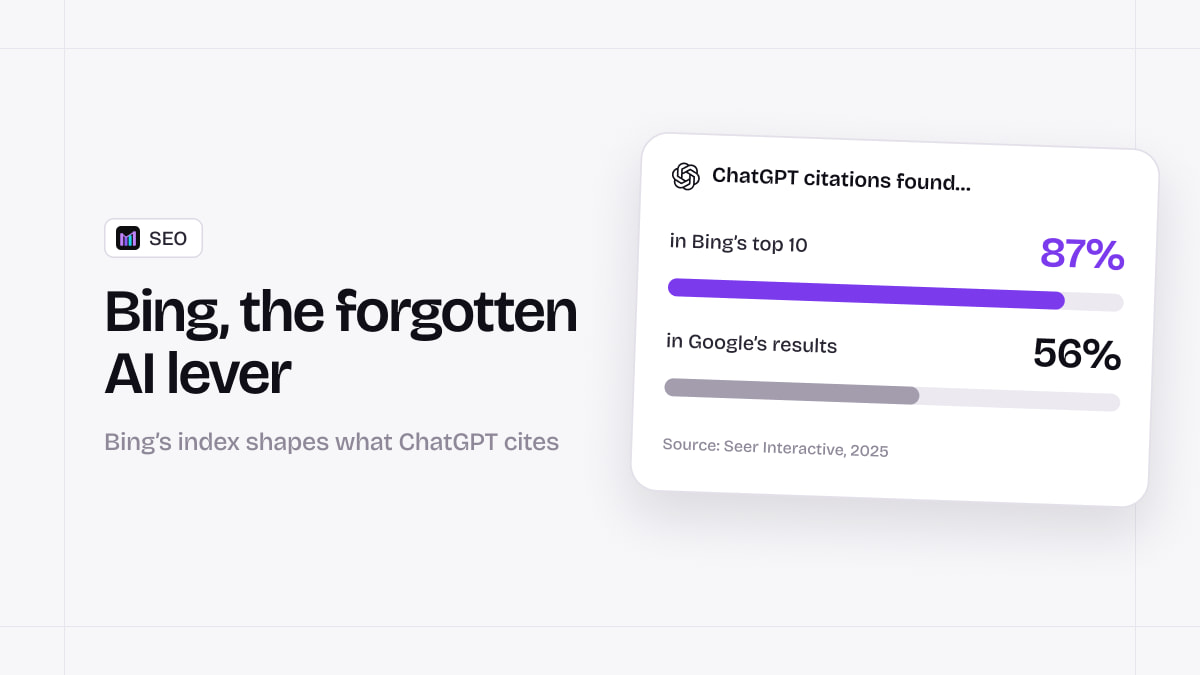
87% of ChatGPT's citations match Bing's top 10, against 56% for Google. Why Bing's index gates your presence in AI answers, and how to get into it.
You have worked your Google SEO for years. Your pages rank, traffic is steady, competitors are not pulling ahead. And yet, when a prospect asks ChatGPT "who would you recommend for X?", it is their names that come back, not yours.
There are several possible explanations. One of them is very concrete, very little known, fixable in an afternoon, and free: your site may be poorly indexed by Bing.
The number that should make you open a Bing account
In February 2025, the agency Seer Interactive did something simple and rarely repeated: it took more than 500 citations produced by ChatGPT's search across 100 queries, then ran the same questions through Google and Bing and compared the URLs by exact match.
The result:
- 87% of ChatGPT's citations matched an organic result in Bing's top 10.
- Only 56% matched a Google result — and at a median rank of 17 and an average rank of 28, which is past page one.
Put plainly: to predict what ChatGPT will cite, your Bing ranking is a far better signal than your Google ranking.
Why: ChatGPT does not read the web, it reads an index
An assistant that "searches the web" is not crawling the internet live for each question. It queries an index that already exists, then writes from what it finds there. For ChatGPT, that index is largely Bing's.
The consequence is blunt, and Search Engine Land put it in one line back in November 2024: "ChatGPT uses Bing's index, so if Bing doesn't have your page, neither does ChatGPT."
This is not a ranking problem, it is an existence problem. A page missing from the index is not ranked badly — it is not a candidate at all. And a page can be perfectly indexed by Google and ignored by Bing: the two crawlers differ in pace, in technical tolerance, and in how much JavaScript they will render.
There is a second door, and it is at OpenAI
Bing is not the only gate. OpenAI runs its own crawler, OAI-SearchBot, and its official documentation is unambiguous: sites that opt out of it "will not be shown in ChatGPT search answers."
So check your robots.txt. A broad block inherited from the days when the goal was to keep models from training on your content may today be keeping you out of the answers themselves. These are two different bots and two different decisions:
- GPTBot feeds model training. Blocking it is a legitimate choice.
- OAI-SearchBot feeds the answers. Blocking it makes you invisible.
Plenty of sites banned both in a single gesture, without realising they were closing the second door along with the first.
Bing Webmaster Tools, step by step
The tool is free and setup takes about twenty minutes.
1. Create the account and import from Google. On bing.com/webmasters, "Import from Google Search Console" pulls in your already-verified properties and sitemaps in a few clicks. It is by far the fastest route and it spares you the whole ownership verification.
2. Otherwise, verify ownership manually. Three options: an XML file at the root, a <meta> tag in the <head>, or a DNS CNAME record.
3. Submit your sitemap. Even if it is already declared in robots.txt, submitting it explicitly speeds up the first pass.
4. Read the index report. This is the step everyone skips, and the one that will actually teach you something. It shows how many of your pages Bing genuinely knows — often a much smaller number than Google Search Console reports. Common causes of the gap: pages rendered only in JavaScript, deep pagination, content behind a form.
5. Use URL inspection on the pages that matter — homepage, service pages, comparisons, case studies. Those are the ones an assistant is likely to cite.
IndexNow: tell them instead of waiting
IndexNow is an open protocol that inverts the crawl. Rather than waiting for the bot to come back, your site announces that a URL has just been created or changed.
Adoption is no longer marginal: in December 2024 Microsoft reported over 3.5 billion URLs submitted per day, and 18% of all new URLs clicked in web search results came from IndexNow.
How you wire it up depends on your platform: a plugin on WordPress, native support on Shopify, Wix or Duda, or a key file at the root plus one HTTP call on publish for a custom build.
One thing to know: Google does not support IndexNow. The protocol serves Bing, Yandex, Seznam, Naver — and therefore, indirectly, the assistants that lean on them. It is work your Google SEO will not do for you.
What you should not conclude
This article would be dishonest if it stopped there, because the ecosystem has moved since the Seer study.
The study is from February 2025 and describes ChatGPT's search as it was then. It is a snapshot, not a law. Eighteen months on, the architecture has become a mixed stack: OAI-SearchBot crawls independently, and various independent analyses have since observed other sources at work depending on the case.
Bing remains the best-documented way in. It is no longer the only one. Anyone telling you "Bing = ChatGPT" is selling you a simplification that will be wrong within six months.
And above all: being indexed guarantees nothing. Indexing is a necessary condition, not a sufficient one. It makes you a candidate; it does not get you cited. What gets you cited is what the models find to say about you — your own pages, yes, but also the directories, the comparisons and the reviews that discuss you elsewhere.
How to know whether it worked
This is the part most guides leave out. You did the work: how do you know it produced anything?
Bing's index report will tell you whether your pages entered the index. It will not tell you whether ChatGPT cites you more. Those are two different measurements, and only the second one is your actual goal.
For the second, you have to ask the assistants the questions your customers ask them — repeatedly, across several models — and count. That is exactly what Mentova does: we query ChatGPT, Gemini and Perplexity on your prompts, record who gets cited, and track how it moves over time.
One honesty note, because it changes how you should read any such result: two calls to the same assistant, minutes apart, do not return the same list of brands. On a fragmented market the overlap can fall to 15%. That is why serious measurement repeats each question several times instead of drawing a conclusion from a single answer — and why you should be wary of any tool that hands you a number without telling you how many answers it rests on.
In short. Open Bing Webmaster Tools, import from Google Search Console, submit your sitemap, read the index report. Check that your robots.txt does not block OAI-SearchBot. Wire up IndexNow if your platform allows it. One afternoon, zero euros.
It will not get you cited by magic. But until it is done, the question does not even arise.
Sources. Seer Interactive, 6 February 2025 · Search Engine Land, 5 November 2024 · Bing Webmaster Blog, 12 December 2024 · OpenAI bot documentation
See what AI says about your brand
14-day trial, no credit card. Your first analysis starts as soon as setup is done.