5 strategies to improve your brand visibility in AI responses
Practical guide to optimize your chances of being mentioned by ChatGPT, Claude, and Gemini — with concrete actions ranked by impact.
Contrary to a common misconception, your visibility in large language model responses is not entirely beyond your control. LLMs like ChatGPT, Claude, and Gemini synthesize information from the web, databases, and third-party sources. By acting on those sources, you can influence how often you're mentioned — and how positively.
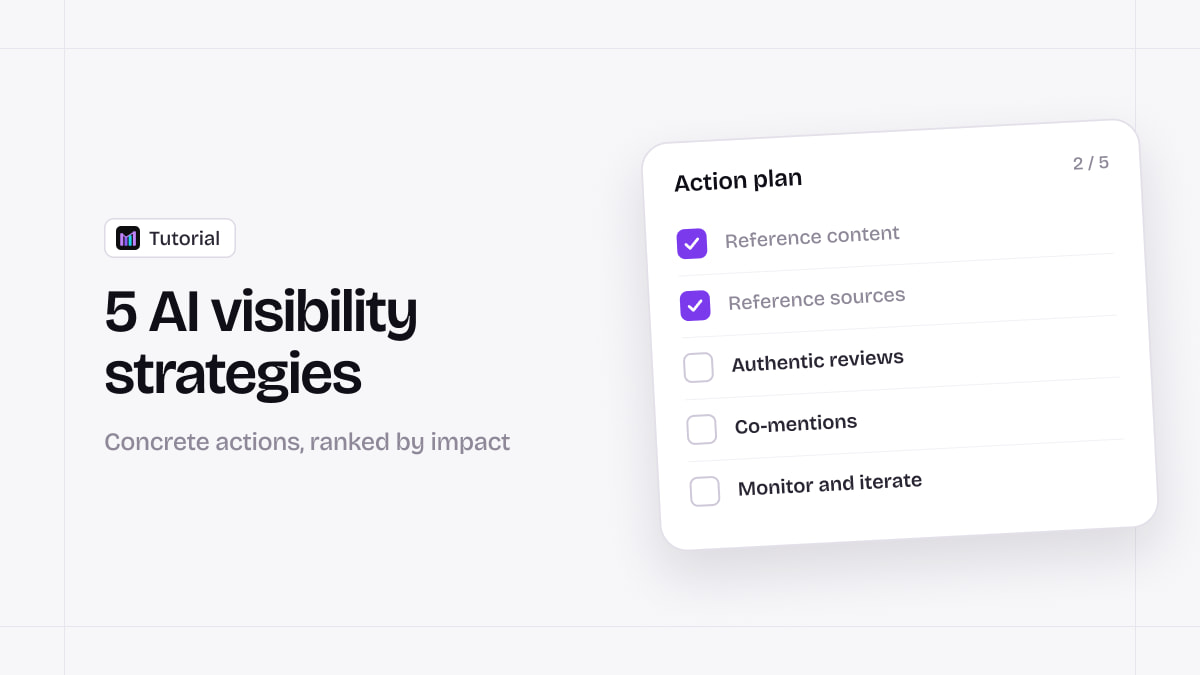
Here are five strategies ranked by impact-to-effort ratio, each with concrete actions you can take today.
Strategy 1 — Create ultra-specific reference content
Why it works
LLMs favor content that directly answers precise questions, cites verifiable data, and adopts a factual, well-structured tone. A 3,000-word article that exhaustively addresses a specific question in your industry is far more likely to be referenced than a generic keyword-optimized post.
Concrete actions
- Identify the 10 to 20 questions your prospects ask most often before purchasing
- Write comprehensive guides ("The definitive list of...", "How to choose..."), industry glossaries, and data-backed case studies
- Add clear definitions, comparison tables, and properly sourced statistics
- Structure content with clear H2/H3 headings, bullet lists, and concise summaries
Example: An HR SaaS vendor that publishes "The Complete Guide to PTO Management (2026 Edition)" — covering all legal requirements, calculation methods, and edge cases — creates exactly the kind of reference content LLMs draw from.
Strategy 2 — Build a presence on LLM reference sources
Why it works
Language models rely on sources they perceive as authoritative: encyclopedias, specialized press, and recognized directories. Being present on these properties directly increases your chances of being included in their responses.
Concrete actions
- Wikipedia — Create or enrich an article about your industry, methodology, or technology, without directly promoting your brand
- Specialist press — Secure coverage in recognized industry publications (interviews, studies, expert op-eds)
- Reference directories — Ensure you're listed on platforms that LLMs consult in your space (G2, Capterra, Product Hunt for SaaS)
- Crunchbase / LinkedIn — Complete, up-to-date profiles send important authority signals
Strategy 3 — Accumulate authentic reviews on third-party platforms
Why it works
AI models treat customer reviews on third-party platforms as reputation signals. A brand with 500 reviews on G2 and a 4.7-star rating will be recommended more often than a competitor with no presence on these platforms.
Concrete actions
- Set up a systematic review collection process (post-onboarding email, in-app prompt after a positive action)
- Focus on 2 to 3 key platforms rather than spreading thin (G2 + Capterra for SaaS, Trustpilot for B2C)
- Respond to every review, positive and negative — it improves overall perception
- Embed review quotes into your web pages to reinforce user-generated content signals
Strategy 4 — Develop co-mentions with high-authority brands
Why it works
LLMs identify recurring associations between brands. If your name regularly appears alongside recognized brands — in integrations, case studies, press articles — your perceived authority increases by association.
Concrete actions
- Official integrations — Build and publish integrations with leading tools in your ecosystem, and get listed in their marketplaces
- Cross case studies — Co-publish case studies with well-known partners or customers
- Tech press mentions — Appearing in a TechCrunch or Forbes article alongside other recognized players strengthens your legitimacy
- Third-party roundups — Ensure that specialist blogs running comparison articles include your solution
Strategy 5 — Monitor and iterate with real data
Why it works
Without measurement, you're optimizing blind. AI visibility shifts as models update, web content evolves, and competitors take action. A regular monitoring cycle lets you detect what's working and adjust quickly.
Concrete actions
- Measure your baseline mention rate before starting any optimization effort
- Run monthly tracking campaigns using a representative set of queries for your industry
- Compare your progress against your main competitors (share of voice)
- Identify the models where you're underrepresented and prioritize your efforts accordingly
- Test one strategy at a time to isolate variables and understand what actually drives results
Summary
| Strategy | Effort | Impact | Timeline |
|---|---|---|---|
| Reference content | High | Very high | 3–6 months |
| LLM source presence | Medium | High | 2–4 months |
| Third-party reviews | Medium | High | 1–3 months |
| Co-mentions & partnerships | High | Medium-high | 3–6 months |
| Monitoring & iteration | Low | Multiplier | Ongoing |
Monitoring has a "low effort" rating because it can be automated — but it's what makes every other strategy effective. Without data, you have no way to know if your efforts are paying off.
Conclusion
Improving your visibility in AI responses is not a one-time project — it's ongoing work that compounds over time. The brands that see the best results combine quality content, presence on the right sources, and consistent performance tracking.
Ready to track your AI visibility? Mentova analyzes your brand mentions across ChatGPT, Claude, Gemini, and Perplexity in minutes.
See what AI says about your brand
14-day trial, no credit card. Your first analysis starts as soon as setup is done.