Complete GEO (Generative Engine Optimization) guide for 2026
Everything you need to know about Generative Engine Optimization: definition, differences from SEO, strategies and tools for 2026.
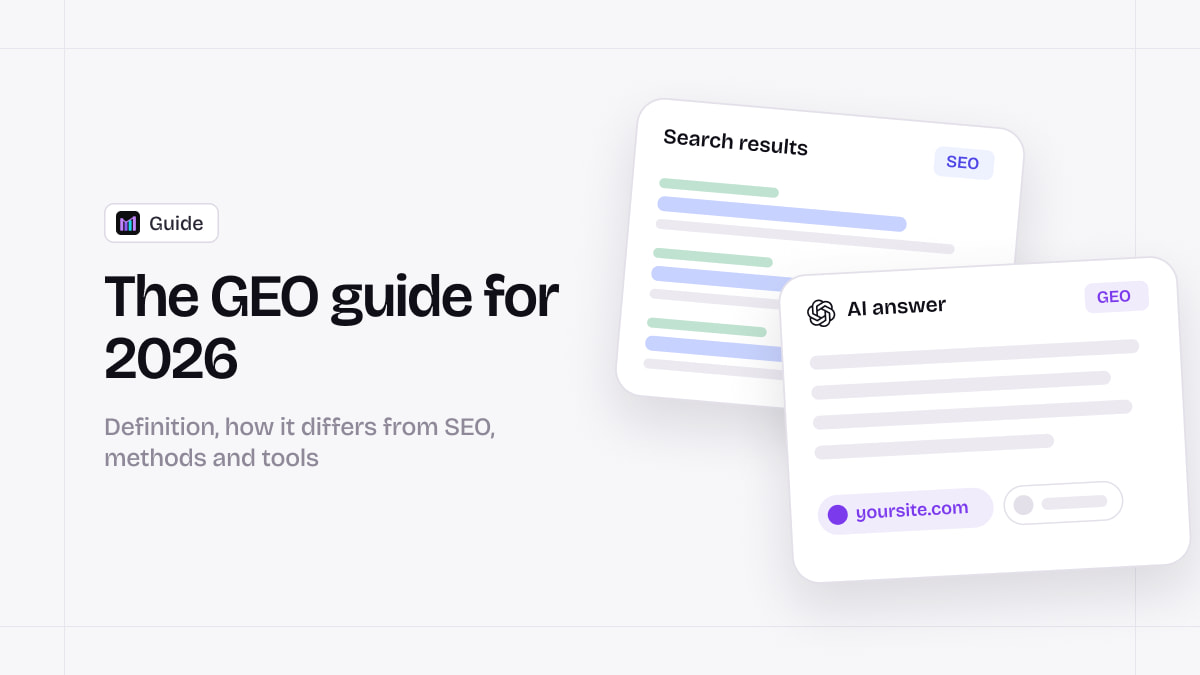
For two decades, optimizing your online presence meant one thing: ranking well on Google. In 2026, that equation has changed. Millions of users now get their answers directly from an AI assistant without ever visiting a search engine. SEO still matters, but it's no longer enough. Welcome to the era of GEO.
What is GEO?
Generative Engine Optimization (GEO) refers to the set of practices aimed at getting your brand mentioned in responses generated by large language models (LLMs) — ChatGPT, Claude, Gemini, Perplexity, and their successors.
In practice, it means acting on the signals that LLMs use to decide which brands, products, and services deserve to be mentioned when a user asks a question. This is not technical SEO: it is authority and reputation management in the age of AI.
GEO vs SEO: a full comparison
| Criterion | SEO | GEO |
|---|---|---|
| Target | Search engine algorithms | Large language models (LLMs) |
| Goal | Rank in search results | Be mentioned in AI responses |
| Primary metric | Position, CTR, impressions | Mention rate, AI share of voice |
| Main lever | Keywords, backlinks, structured data | Brand authority, citations, factual content |
| Measurement | Google Search Console, SEMrush | Dedicated AI tracking tools |
| Time to results | 3–6 months | 2–5 months |
| Durability | Depends on Google rankings | Depends on model updates |
SEO and GEO are not opposites — they complement each other. A strong content strategy improves both. But the metrics and tactics diverge enough to justify a distinct approach.
The 3 pillars of GEO
Pillar 1 — LLM-friendly content
LLMs favor content that directly answers questions, cites verifiable data, and adopts a clear, structured format.
To create LLM-friendly content:
- Write precise definitions for key terms in your industry
- Publish comprehensive guides that cover a topic from start to finish
- Cite reliable sources and include data points with numbers
- Structure with clear headings, lists, and comparison tables
- Avoid marketing jargon — favor an informative, neutral tone
Pillar 2 — Brand authority
LLMs do not "trust" all brands equally. The authority signals they recognize include: presence on Wikipedia, mentions in recognized press, reviews on third-party platforms (G2, Trustpilot), integrations with leading tools, and consistency of information across the web.
Building this authority takes time, but it is a durable investment. A brand well-anchored in LLM reference sources will remain there even through model updates.
Pillar 3 — Monitoring and measurement
Without tracking, GEO stays theoretical. You need to regularly measure your mention rate, your share of voice against competitors, and variations by model (ChatGPT vs Claude vs Gemini). This data lets you identify what's working and direct your efforts accordingly.
GEO Checklist 2026
Here are 15 actionable points to assess and improve your AI presence.
Content
- Do you have a comprehensive guide for every major question in your industry?
- Do your pages include clear definitions of important concepts?
- Do you use data points and cited sources throughout?
- Is your content structured with clear H2/H3 headings?
- Do you have a detailed FAQ covering common objections?
Authority and sources
- Is your brand mentioned on Wikipedia (directly or indirectly)?
- Do you have press coverage in recognized publications?
- Are you listed on G2, Capterra, or the reference directories in your industry?
- Are your Crunchbase and LinkedIn profiles complete and up to date?
- Do you have official integrations with leading tools in your ecosystem?
Reputation
- Do you have more than 50 reviews on at least one third-party platform?
- Is your average rating above 4.0 stars?
- Do you respond consistently to customer reviews?
Measurement
- Do you measure your AI mention rate at least once a month?
- Do you track your share of voice against your top 3 competitors?
How long before you see results?
| Actions | Estimated timeline |
|---|---|
| Review collection, directory profiles, FAQ content | 1–3 months |
| Press coverage, comprehensive reference content | 2–4 months |
| Wikipedia authority, partnerships and integrations | 4–6 months+ |
One thing is certain: the earlier you start, the harder your competitive lead will be to close.
Frequently asked questions
Does GEO replace SEO?
No. Both channels coexist and reinforce each other. Good SEO content is often good GEO content too. But the success metrics and some tactics diverge enough to warrant a distinct strategy.
Can I "force" an LLM to mention my brand?
No. There is no direct way to pay or instruct an LLM to cite you. However, by improving the quality, authority, and distribution of your information, you naturally increase the likelihood of appearing in responses.
Does GEO work for small businesses?
Yes, and sometimes better than SEO. On specific niches, a small brand with strong positioning on a few precise topics can outperform larger players that have not yet adapted to GEO.
How do I know if my GEO efforts are paying off?
By regularly measuring your mention rate before and after each action. Without baseline data, it's impossible to assess impact.
Conclusion
GEO is not a passing trend — it is the logical response to a lasting transformation in user behavior. Companies that integrate this discipline into their marketing strategy today will build a substantial lead over competitors who are slower to adapt.
Ready to track your AI visibility? Mentova analyzes your brand mentions across ChatGPT, Claude, Gemini, and Perplexity in minutes.
See what AI says about your brand
14-day trial, no credit card. Your first analysis starts as soon as setup is done.