How do AI models decide which brands to recommend?
Understanding the mechanisms that make ChatGPT, Claude, and Gemini mention some brands and not others.
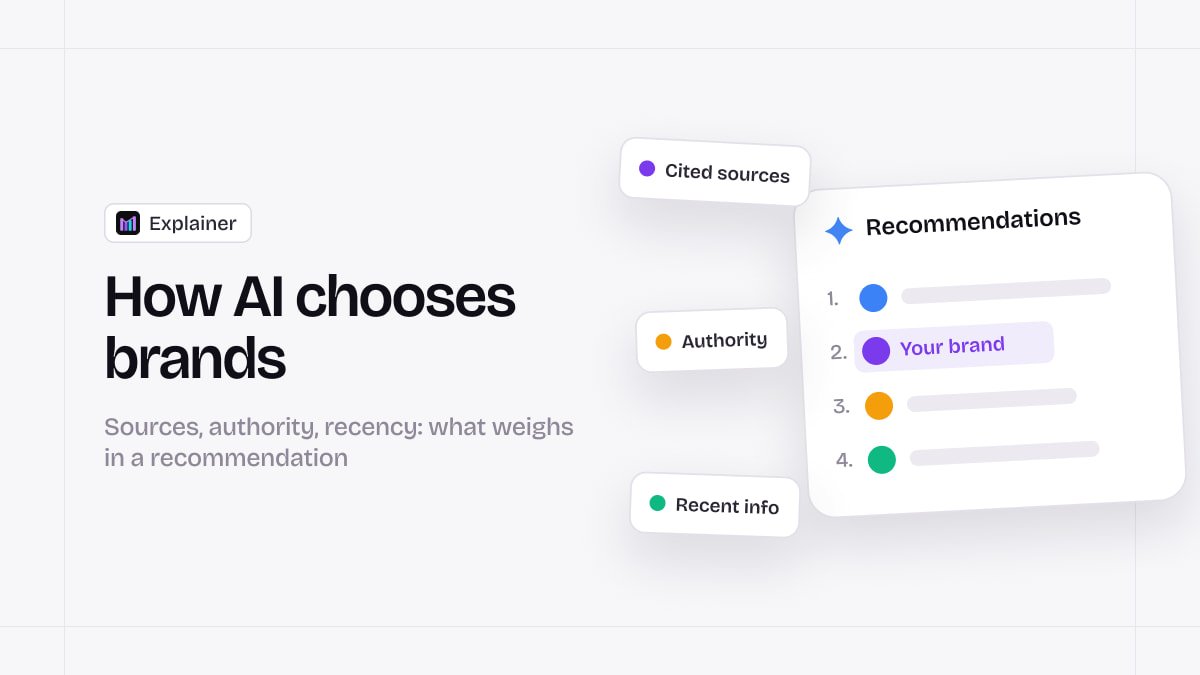
When you ask ChatGPT "What CRM would you recommend for a startup?", the answer feels like an impartial assessment. In reality, it is the product of a set of statistical mechanisms and patterns learned from billions of documents. Understanding those mechanisms is the first step toward optimizing your AI visibility.
The LLM black box
Large language models do not maintain an editorial ranking of brands. They have no conscious preferences. What they do is predict the most probable and coherent text in response to a question — based on statistical associations learned during training.
Your visibility in AI responses is directly proportional to how your brand was represented in the data these models were trained on.
The factors that influence AI brand mentions
1. Volume and quality of training data
The first factor is volume: how many times is your brand mentioned in the corpora used to train the model? But volume alone is not enough. The quality of sources matters just as much.
A mention in an industry annual report, a long-form article in a specialist journal, or a well-documented Wikipedia page carries far more weight than hundreds of mentions in forum comments or low-quality articles. Models learn to distinguish credible sources from unreliable ones.
2. Source authority and credibility
LLMs have internalized implicit notions of authority. Information from academic sources, recognized publications, encyclopedias, and specialist review sites has a disproportionate influence on their responses.
This is why a strong presence on G2, Capterra, or in leading publications in your industry has an outsized impact on your AI visibility.
3. Information recency and RAG
Models have a knowledge cutoff date. For queries that involve recent information, some systems use Retrieval-Augmented Generation (RAG) — a technique that allows the model to fetch real-time information from the web.
For these models (Perplexity, ChatGPT with browsing, Gemini with Google), your organic search rankings for recent queries become a direct AI visibility factor. An active blog with regularly updated content is therefore an asset not just for SEO, but for GEO as well.
4. Co-occurrence frequency with key terms
LLMs operate through associations. The more your brand is mentioned alongside specific terms relevant to your industry — "accounting software," "collaboration tool," "analytics platform" — the stronger the connection the model builds between your brand and that context.
This co-occurrence is built through comparison articles, selection guides, integrations with other tools, and mentions in contexts where your product category is actively discussed.
Differences between ChatGPT, Claude, and Gemini
The three leading models do not share the same training corpora or the same internal approaches, which creates notable differences in their recommendation behavior.
| Model | Primary bias | Recommendation behavior |
|---|---|---|
| ChatGPT (OpenAI) | Strong bias toward English-language and US tech content | Favors brands with a well-established presence on review platforms |
| Claude (Anthropic) | More cautious, sensitive to editorial quality | Tends to present several alternatives rather than a single recommendation |
| Gemini (Google) | Benefits from access to Google Search data | Brands that rank well on Google have a natural advantage |
This disparity underlines the importance of measuring your visibility on each model separately rather than assuming uniform coverage.
What brands can control
| Factor | Control level | Possible actions |
|---|---|---|
| Reference content | High | Guides, case studies, glossaries |
| Presence on review platforms | High | G2, Capterra, Trustpilot |
| Press mentions | Medium | PR, guest contributions |
| Wikipedia page | Medium | Creation / enrichment |
| Industry co-mentions | Medium | Partnerships, integrations |
| Past training data | None | Cannot be changed retroactively |
| Model's internal algorithm | None | LLM black box |
What brands cannot control
It is important to be clear-eyed: you cannot directly control a LLM's algorithm, nor the biases it internalized during training. Some models will have intrinsic preferences for well-established brands even before you publish your first optimized piece of content.
The good news: models are updated regularly, and new models emerge constantly. An AI visibility strategy built today can pay dividends during the next training update cycle.
How retrieval (RAG) is rewriting the rules in 2026
Two years ago, AI brand visibility was almost entirely a function of training data — a slow-moving snapshot you could only influence over many months. That is no longer true. The fastest-growing AI surfaces now retrieve live web results at answer time:
- Perplexity retrieves and cites its sources in every answer. If you earn a citation on the right page, you can appear almost immediately.
- ChatGPT with browsing / search pulls fresh results for time-sensitive questions.
- Google's AI Overviews and AI Mode (powered by Gemini) synthesize answers directly from the Google index.
The practical consequence: your recent organic content and your presence on frequently-retrieved sources now influence AI answers on a timescale of days and weeks, not just the next model training cycle. Retrieval is the lever you can pull now. This is why understanding which sources influence AI recommendations has become the single highest-leverage GEO skill.
A practical checklist to influence AI recommendations
If you want to move from theory to action, work through this in order:
- Fix your entity foundations — accurate Wikipedia/Wikidata entry (if you qualify), consistent brand naming across the web, a fact-dense "about" page.
- Build presence on high-authority review sources — complete, well-reviewed profiles on G2, Capterra, Trustpilot and the directories specific to your category.
- Publish structured, answer-shaped content — comparison pages, selection guides and glossaries that directly answer buying-intent questions.
- Engineer co-mentions — get named alongside established leaders through integrations, partnerships and "best tools" listicles.
- Keep it fresh — a regularly updated blog feeds the retrieval layer, not just SEO.
- Measure per model — track ChatGPT, Claude, Gemini and Perplexity separately, because the same effort moves them differently.
Frequently asked questions
Can I make ChatGPT recommend my brand? Not directly or instantly — you can't edit the model. But you can change what the model reads about your category (sources, reviews, co-mentions) and, for retrieval-based surfaces, influence answers within weeks. Consistency across trusted sources is what shifts recommendations over time.
Why does my brand appear in one AI model but not another? Each model is trained on different data and weighs sources differently, so the same question can produce a different brand shortlist. That's why you should track each model separately rather than assume uniform visibility.
How long does it take to change my AI visibility? For retrieval-based answers (Perplexity, AI Overviews, ChatGPT search), changes can show up in days to weeks as new content is indexed. For pure training-data knowledge, it depends on the next model update cycle — months. Most brands see the fastest wins on the retrieval layer.
What's the single most important factor? There isn't one — it's the consistency of how your brand is described across the sources a model trusts. A strong G2 profile, an accurate Wikipedia entry, and regular co-mentions compound. Measuring your AI share of voice tells you whether that compounding is working.
Conclusion
Visibility in AI responses is not random. It results from a structured web presence, quality content, and a consistent co-mention strategy. Understanding the mechanics of LLMs is the first step toward leveraging them to your advantage.
Want to see how your competitors are outperforming you on ChatGPT, Claude, and Gemini? Mentova lets you visualize your AI Share of Voice by model, identify prompts where your brand is absent, and track your progress over time. Start with a ChatGPT visibility tracker or Gemini visibility tracker for your brand — 14-day free trial, no credit card.
Related reading: How to appear in ChatGPT answers · Which sources influence AI recommendations · AI Share of Voice explained
See what AI says about your brand
14-day trial, no credit card. Your first analysis starts as soon as setup is done.