Which Sources Influence AI Recommendations (and How to Find the Ones Citing Your Brand)
AI models like ChatGPT and Perplexity recommend brands based on the sources they trust. Learn which sources influence AI answers and how to find the ones citing — or ignoring — your brand.
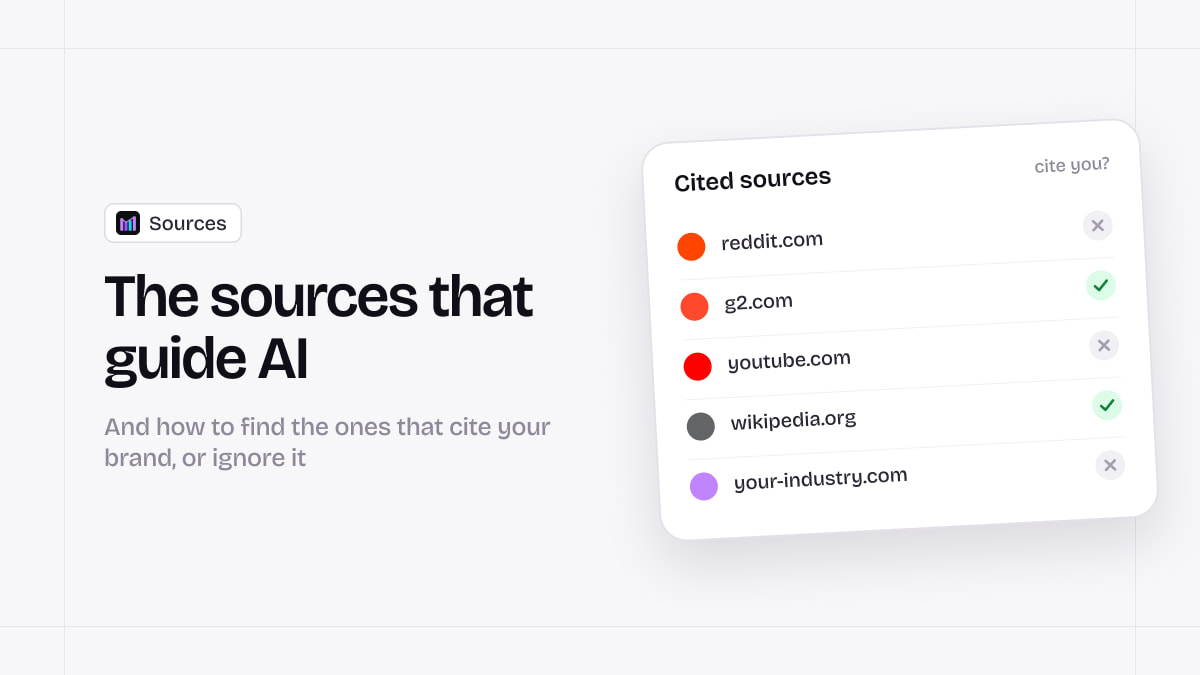
When ChatGPT, Perplexity or Gemini recommends a brand, that recommendation didn't come from nowhere. The model learned it from sources — the websites, reviews, forums and articles it was trained on or retrieves from. If you want to understand why an AI assistant recommends a competitor instead of you, the answer is almost always in the sources.
You can't change how a model thinks. But you can change what it reads about your category — and that is what moves your visibility.
This guide explains which sources influence AI recommendations, how to find the ones that are citing your competitors, and what to do about the ones ignoring you.
Why sources decide AI recommendations
Large language models don't have opinions about brands. They reproduce patterns from their training data and, increasingly, from live web results they retrieve at answer time (as Perplexity and Google's AI Overviews do). When a brand is described consistently and positively across many trusted sources, the model treats that as a signal: this brand belongs in the answer.
This is the core difference between traditional SEO and Generative Engine Optimization (GEO). SEO is about ranking your own pages. GEO is about being described favorably on the sources the model already trusts — many of which you don't own.
The sources AI models trust most
Across categories, a recognizable set of sources shows up again and again behind AI recommendations:
- Wikipedia — foundational for entity understanding. If your brand has a well-maintained, notable entry, models treat you as a real, established entity.
- Reddit and community forums — heavily weighted by ChatGPT and Perplexity because they read as authentic, unsponsored opinion.
- Review and comparison sites — G2, Capterra, TrustRadius, TrustPilot, Gartner Peer Insights for B2B; category-specific review sites elsewhere.
- Directories and "best of" listicles — "best [category] tools 2026" articles are a primary place models pull shortlists from.
- Authoritative editorial coverage — major news outlets, respected industry blogs and analyst notes.
- Your own site — still matters, especially for structured, fact-dense pages a model can quote.
The exact mix varies by industry and by model. Perplexity, which cites its sources in every answer, is the easiest place to observe this directly: ask it a buying-intent question in your category and read which pages it links.
How to find the sources citing your brand (and your competitors)
There are three levels of effort:
1. Manual spot-checks
Ask Perplexity (or ChatGPT with browsing) a handful of real category questions — "best [category] tool for [use case]", "alternatives to [competitor]" — and note which brands appear and which sources are cited. This is free and surprisingly revealing, but it's a snapshot, not a trend, and you can only hold a few prompts in your head.
2. Track it systematically
The limitation of manual checks is coverage: AI answers shift between models, between phrasings, and over time. To see the full picture you need to run many prompts across many models on a schedule and aggregate the sources behind each recommendation. This is exactly what an AI visibility platform does — it turns scattered observations into a ranked benchmark of the sources influencing your category.
3. Map the gaps
The most useful output isn't "here are the influential sources" — it's "here are the sources putting your competitor in the answer where you're absent." That gap list is your action plan.
What to do once you know the sources
Finding the sources is only valuable if you act on them. A practical sequence:
- Fix your foundations. Ensure your Wikipedia entry (if you qualify), your site's key pages, and your profiles on major review sites are accurate, complete and fact-dense.
- Earn presence on the high-influence sources you're missing. If competitors are recommended because of a G2 category page or a Reddit thread or a "best tools" listicle, that's where to focus — through legitimate reviews, genuine community participation, and outreach to the authors of those listicles.
- Publish content that answers the question directly. Models favor sources that clearly and structurally answer the buying-intent question. Comparison pages, how-to guides and well-structured category content all help.
- Re-measure. Source influence and AI answers change constantly. Track your mention rate over time so you can tell whether your work is actually moving the needle.
How Mentova helps
Mentova is built around this exact loop. It runs your category prompts across 20+ AI models on a schedule, captures every brand mentioned and every source cited, and maintains a ranked benchmark of the sources that most influence recommendations in your category. For every prompt where a competitor is recommended and you aren't, it surfaces the sources behind that recommendation and generates the content to help you close the gap.
In other words: it tells you which sources are citing your competitors, which are ignoring you, and exactly what to do about it.
Want to see which sources are shaping AI's view of your brand? Try it free for 14 days, no credit card required.
Related reading: How LLMs choose which brands to recommend · AI Share of Voice explained · What is GEO?
See what AI says about your brand
14-day trial, no credit card. Your first analysis starts as soon as setup is done.